Welcome to the Controlled Chemical Reactions group!
What exactly happens during a chemical reaction? Our aim is to completely understand and, ultimately, fully control chemical reactions on the molecular level. We therefore investigate reactive collisions, in which chemical bonds are broken and new bonds are formed, between individual molecules in the gas phase. We make use of advanced experimental techniques to study these reactions in extremely high detail.
Our group is part of the Spectroscopy of Cold Molecules department within the Institute for Molecules and Materials of the Radboud University.
Latest news
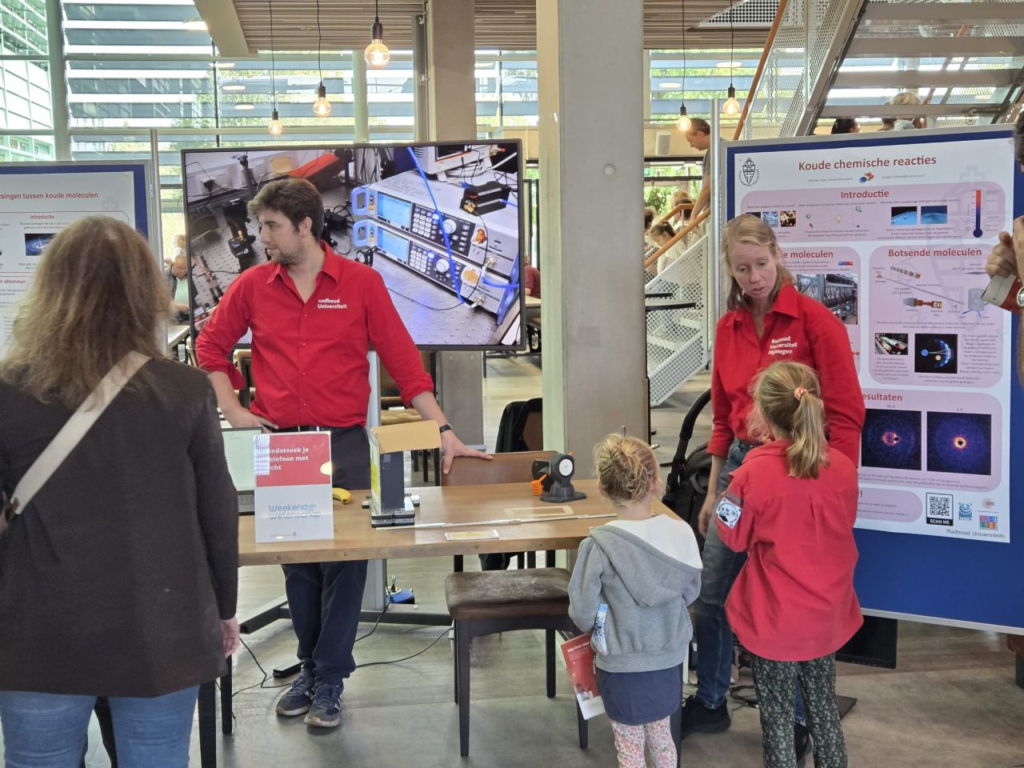
3 October: We participated during the Open Day at the Radboud Faculty of Science. We gave lab tours, talked about our research, and demonstrated a small experiment. It was great to meet so many curious visitors and share our enthusiasm for science!
23 September: Science communicator Bob Stienen talks about our research in this short Instagram reel. Thanks a lot Bob!
11 September: This week, Jolijn attended the MOLEC conference in Freiburg, Germany, where she was awarded the Zdeněk Herman MOLEC Young Scientist Prize and afterwards presented our work. What an honour!

31 August: Robin Verwegen joins us for his MSc internship. Welcome!
3 August: Philip Pearcy joins us for a postdoc. Welcome!
26 July: Jolijn recorded an episode of the podcast Geschiedenis van de Natuurkunde (History of Physics) with Jan van Riswick about our research. What an exciting experience! You can listen to the episode here.
26 June: Dong joined the Quantum Reactive Scattering Workshop in Gdańsk, Poland, and Jolijn attended the Stereodynamics conference in Madrid, Spain, this week. We both presented our work, and are greatful for all inspiring talks, posters, and discussions!
9 June: We have an open postdoctoral position! Get in touch if you’re interested!
Recent publications
- Intense and controlled beam of S(1D2) atoms
Alexandra Tsoukala, Saskia Bruil, Niek Janssen, Saskia Pieters, Jolijn Onvlee
Phys. Rev. A 112, 053113 (2025), arXiv:2508.02302 - Revisiting the inverse Abel integral for reconstructing velocity-map images
Chris Sparling, Jolijn Onvlee
Phys. Chem. Chem. Phys. 27, 18694 (2025) - Imaging Resonance Effects in C + H2 Collisions using a Zeeman Decelerator
Vikram Plomp, Xu-Dong Wang, Jacek Kłos, Paul J. Dagdigian, François Lique, Jolijn Onvlee, Sebastiaan Y.T. van de Meerakker
J. Phys. Chem. Lett. 15, 4602 (2024), arXiv:2312.00203